
Table of Contents
- Modern Wall Art for Young Professionals: What to Buy First
- Quick Comparison: 7 Modern Wall Art Pieces by Price
- Best Wall Art for Apartment Renters: Damage-Free Hanging
- Home Office Wall Art: Styling Your Video Call Background
- Large Wall Art for Living Room: Sizing It Right
- Gallery Wall Ideas for Small Apartments and Multipurpose Rooms
- Original, Print, Canvas, or Digital: What Your Money Buys
- Mistakes That Make Modern Wall Art Look Cheap
- Frequently Asked Questions
Last Updated: October 12, 2026
Modern Wall Art for Young Professionals: What to Buy First
Modern wall art for young professionals is original or printed artwork chosen to fit rental-friendly spaces, hybrid work setups, and a starter budget.
Start with one anchor piece rather than five small ones. A single large canvas or framed print does more for a room than a scattered collection, and costs less than most people expect when you skip custom framing.
Quick Comparison: 7 Modern Wall Art Pieces by Price
Every piece below is an original from our gallery, so you can compare materials, sizes, and prices before you commit.
| Piece | Size | Medium | Price | Best For |
|---|---|---|---|---|
| Sun Blossom | 24"x36" | Acrylic on 98lb paper | $325 | First apartment, entryway |
| Wild Waters | 24"x36" | Acrylic on 98lb paper | $325 | Living room, coastal style |
| Window Rain | Acrylic on canvas | Canvas | $325 | Bedroom, quiet corner |
| Wilderness Cabin | Acrylic on canvas | Canvas | $325 | Home office backdrop |
| Clift Lighthouse | 12"x16" | Acrylic on canvas gallery wrap | $675 | Gallery wall anchor |
| Summer Somewhere | 24"x24" | Acrylic on canvas gallery wrap | $895 | Bold accent wall |
| Summer | 24"x36" | Acrylic on canvas gallery wrap | $2,010 | Collector statement piece |
| Spring | 24"x36" | Acrylic on canvas gallery wrap | $2,010 | Collector statement piece |
The $325 tier covers the widest range of styles, which matters when you are still figuring out your taste.

Best Wall Art for Apartment Renters: Damage-Free Hanging
Rental-friendly hanging comes down to one rule: match the hardware to the wall, not the frame. Adhesive strips hold lightweight framed prints and posters, and gallery wraps under roughly 2 kilograms. Anything heavier needs a nail-free hook rated above the piece's weight.
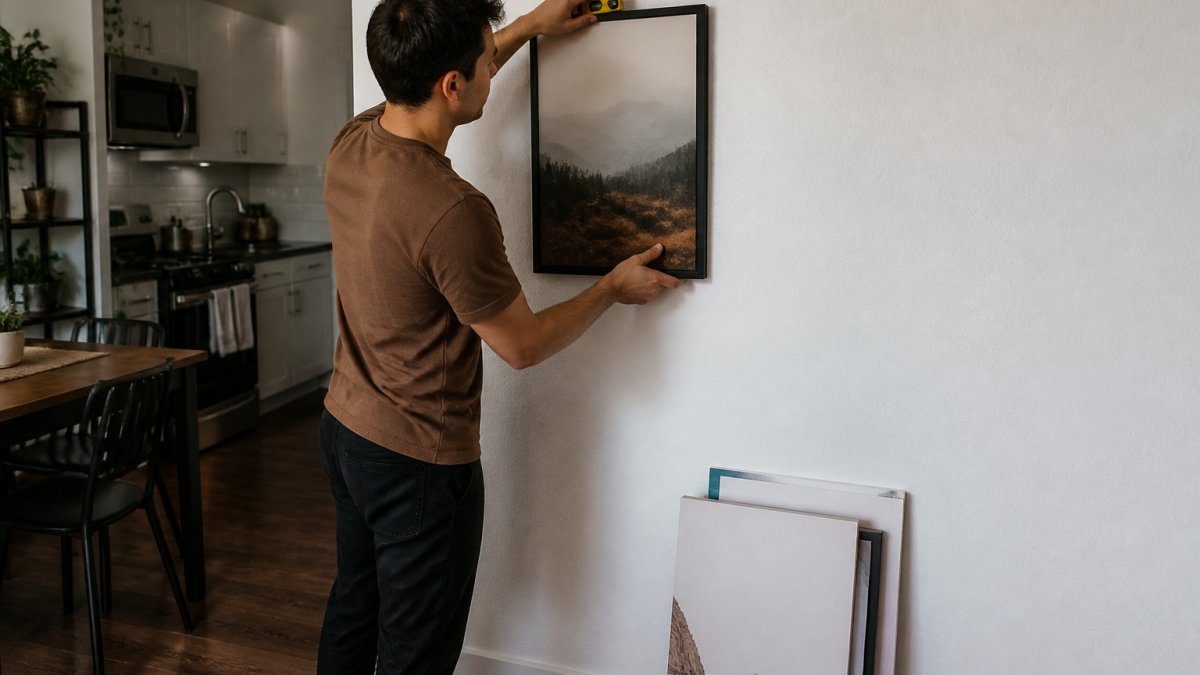
Command Strips, Nail-Free Hooks, and Weight Limits
Adhesive strips work for prints and posters but fail on heavy gallery wraps. Check the package weight rating, add a 50% safety margin, and clean the wall with rubbing alcohol first. Nail-free hooks handle more weight but leave small holes, so patch them with spackle before move-out.
Home Office Wall Art: Styling Your Video Call Background
Home office wall art should sit behind your camera at eye level, roughly 12 to 18 inches above your monitor, filling the frame without crowding your face. A single 24"x36" piece beats a busy gallery wall, which reads as visual noise on compressed video.
Wilderness Cabin, at $325, is our most-requested piece for this use: its muted palette and narrative composition give the frame depth without pulling attention from you.
Large Wall Art for Living Room: Sizing It Right
Large wall art for a living room should cover roughly two-thirds to three-quarters of the wall width above your sofa. Measure the furniture first, then buy the art. A 24"x36" canvas suits a loveseat or narrow apartment wall; wider sectionals need a multi-panel arrangement or one oversized piece.
The 60-Inch Rule and Why It Fails on Small Walls
The 60-inch rule says art should span 60 inches above a sofa. It assumes a standard three-seat couch in a full-size room, which describes very few first apartments.
Use the two-thirds rule instead, and leave at least 6 inches of breathing room on each side. Summer Somewhere, a 24"x24" gallery wrap at $895, hits the right proportion for a compact living room without dominating it.

Gallery Wall Ideas for Small Apartments and Multipurpose Rooms
Gallery wall ideas for small apartments work best when the arrangement does two jobs: it reads as a single unit, and it visually zones a multipurpose room.
Start with the shape, not the art. A grid of four or six equal frames reads as one block, making a compact room feel organized rather than cluttered. A vertical column of three draws the eye upward and makes a low ceiling feel taller.
Scale Math for Small Walls
Measure the wall span first, then work backward. Renters commonly leave 8 to 12 inches of empty wall on each side and keep the gallery's total width at roughly 60 to 75 percent of the furniture below it.
Keep gaps between frames consistent at 2 to 3 inches. Tighter gaps (1.5 to 2 inches) make the group read as one piece; wider gaps (4 inches or more) make each frame feel like a separate purchase and clutter a small wall.
Rental-Friendly Installation for Gallery Walls
A gallery wall is where rental damage adds up fastest, four to nine holes in one area. Two approaches keep the deposit intact:
- Adhesive strips for lightweight frames. Most are rated for a few pounds each. Use two strips per frame for anything wider than 8 inches, and clean the wall with rubbing alcohol first. Works for posters and lightweight framed prints, not heavy gallery wraps.
- A single French cleat or picture rail for heavier pieces. One anchored rail spreads the load across one or two holes instead of nine, and you can reposition frames along it without new holes, the cleaner option when your anchor piece is a canvas.
If you must use nails, plan the layout on paper templates first, tape them to the wall for a full day, and live with the arrangement before committing. Patching a few small holes at move-out is routine; patching a dozen is a weekend project.
Building the Arrangement
Anchor the arrangement with one larger piece, then build outward with smaller ones. Clift Lighthouse, a 12"x16" gallery wrap at $675, works as a center point, with cheaper prints filling the surrounding frames. Prints of every piece are available through our ArtPal storefront if you want to test a composition first.

- Measure the full wall span before buying frames
- Cut paper templates and tape them up for a day before committing
- Keep one consistent frame color across the whole arrangement
Original, Print, Canvas, or Digital: What Your Money Buys
Originals are one-of-a-kind and hold resale value. Prints cost a fraction of the original and let you rotate pieces as your taste shifts. Canvas and acrylic prints sit between the two, offering texture and durability at a moderate price.
For a first apartment, prints make the most sense: you get the look without locking in a large purchase, and can upgrade to an original later once you know what you like.
Mistakes That Make Modern Wall Art Look Cheap
Most "looks cheap" problems are not about the art, they are about scale, repetition, and whether the collection looks intentional. The mistakes below separate a first apartment that looks designed from one that looks assembled.
Buying a Set Instead of a Collection
A matching set of three prints from the same product page reads as a purchase, not a point of view. Buy one anchor piece you genuinely love, then add pieces over months as you notice what you are drawn to. A collection built over a year looks personal; a set bought in one afternoon looks generic.
Sizing Down to Save Money
An undersized piece on a large wall is the fastest way to make a room look unfinished, and the most common budget mistake. A 12"x16" print centered on a 90-inch wall looks like a placeholder. If the budget only covers a small piece, hang it in a small zone, a hallway, desk nook, bathroom, and wait on the large wall until you can afford the right scale.
Ignoring the Video Call Frame
If you work from home, your wall art has a second audience: your camera. A piece hung too low gets cropped at the top of the frame; a glossy canvas catches glare from a monitor or window and washes out on compressed video. Test the background before you commit, join a meeting with yourself, screenshot the frame, and check whether the art is cropped awkwardly or competing with your face.
Letting the Frame Fight the Room
Frame finishes should either match across a room or repeat at least once. A black, gold, and raw wood frame in the same sightline reads as three separate decisions. Pick one finish as the default and allow a second only if it echoes something else in the room, a lamp base, a drawer pull, a curtain rod.
Hanging at the Wrong Height
Hang art at eye level, roughly 57 to 60 inches from the floor to the center of the piece. In a rental, this height also keeps the piece in frame on video calls and at seated eye level from a sofa. Art hung near the ceiling makes even expensive pieces look like afterthoughts.
Skipping the Color Pull
Pull one or two colors from the art into your textiles, a throw pillow, a rug, a lamp shade. That is what makes a room read as designed rather than assembled. You do not need an exact match; one visible echo connects the wall to the rest of the room.
- Art hung near the ceiling instead of eye level
- Mixed frame colors with no repeating element
- A small print centered on a wide, empty wall
Frequently Asked Questions
What kind of wall art looks modern right now?
Texture, oversized statements, and soft modern color palettes are the dominant themes in 2026 wall art trend reporting. In practice that means abstract pieces with visible brushwork, minimalist compositions with one strong focal point, and large single pieces rather than dense clusters of small frames. Graphic prints and street-art-inspired work also read as current. The safest modern look is one large piece with a limited color palette pulled from something already in the room, not a themed set bought all at once.
How do I choose wall art for a small apartment?
Measure the wall before you shop, then buy one piece at roughly two-thirds the width of the furniture below it. In a small apartment, a single 24x36 inch piece usually outperforms three smaller frames because it reduces visual clutter and makes the room feel larger. Stick to lighter frames and avoid heavy dark borders that shrink the wall. Damage-free adhesive hooks handle most prints up to a few pounds, so you can rearrange without patching nail holes when you move.
What size wall art should I buy for my living room?
For a sofa, aim for art that spans about two-thirds of the sofa width. A standard 24x36 inch canvas works over a 60-inch couch, while a 24x24 inch square suits a narrower loveseat or a reading corner. Hang the center of the piece 57 to 60 inches from the floor so it sits at eye level. If the wall is tall and empty, one oversized piece reads better than a row of small ones stacked to fill the same height.
Is framed art or canvas better for a modern home?
Canvas gallery wraps suit modern interiors because they sit flush against the wall with no frame to compete with the artwork. Framed prints give you more control over the look and protect the surface, which matters for paper-based pieces. A 24x36 inch acrylic on 98lb paper needs a frame; a gallery-wrapped canvas does not. If you rent and move often, canvas is lighter and less likely to crack in transit, while frames with glass need more careful packing.
How can I make affordable wall art look more polished?
Match the frame or canvas edge to your existing hardware and lighting rather than buying a matching set. Consistent frame color across a gallery wall does more for the look than expensive individual pieces. Hang at eye level, keep 2 to 3 inches between frames, and light the wall with a warm bulb. A single well-placed large piece at $325 often looks more intentional than five cheap prints scattered across the same wall.
Choosing art for a first apartment is a test of restraint: one good piece beats five mediocre ones every time. Mind-Meld Gallery offers fine art prints, print framing, canvas, acrylic prints, and metal prints, all backed by a money-back guarantee, so you can try a piece in your space and return it if the colors do not work. Start with a single anchor piece, hang it at eye level, and build from there. Browse the collection and find the piece that makes your apartment feel like yours.